 Tea shop like this will be over in the next couple years in Hanoi!
Thursday, September 20, 2007
Friday, August 17, 2007

Thursday, August 16, 2007
Planning for hundred years!

For the benefits of ten years, one should plant trees. But for the benefits of hundred years, one should plant the seeds in people. Last week, the HSBC asked me to join them on this long-term committments to people.
Sunday, August 12, 2007
Visit Ha Tien Kien Giang Province

Mac Cuu's Temple
We had a short visit to Ha Tien, Kien Giang Province on August 4-5, 2007. It is a small town but in my opinion, it is the most beautiful town in the Mekong Delta. We visited Mac Cuu's temple and his tomb. He was the founder of Ha Tien. According to the story I read from his temple, Mac Cuu came to Ha Tien three hundred years ago from China. He finally dedicated this land to the Nguyen dynasty.
Ha Tien is bordering with Campuchia. We came to see Xa Xia border gate. However, we did not see much trading activities through the gate.
Ha Tien has few limestone hills. I do not like ideas using this stone to make cement here. In the past, due to lack of raw materials for making cement, the former regime built Ha Tien Cement Factory here. However, two parts of Vietnam were united in 1975. Cement nowaday can make in North Vietnam and transport to the South. We do not need to destroy the beautiful landscapes of Hatien. What happens if one day those hills in Ha Tien disappear?
Sunday, June 03, 2007
Nobel Peace Prize winner urges graduates to 'create the world we deserve'
The following is a transcript of Grameen Bank founder Muhammad Yunus’ remarks at Senior Class Day on May 10, 2007.
Thank you. Thank you, Chancellor Gee. Good morning. What a great day! Definitely it is a great day for me – I just got $100,000! So I make you the witness, and for a guy who lends out $20, $30, that is a lot of loan here. You can reach out to so many people, and I’m very happy to be here. I feel like I am back home. When you spend seven years of your life in a place which is full of memories of your young days, that is your real home. So today, for me, is a homecoming. And Vanderbilt has played a very, very significant role in my life, and I often mention where I am from. I am from Vanderbilt. One thing Vanderbilt has done to me: Vanderbilt has made me bold, made me dare, and that helped in defying things and, unless I had gained that defiance in me, I wouldn’t be able to do the things I did. When I left Vanderbilt campus, I went to MTSU to teach in Murfreesboro. That was a wonderful experience. I taught there for three years. I saw the other side of the university life as a teacher. That prepared me to start a teaching life when I go back. I went back after seven years in Nashville and I felt that I had acquired the experience that I needed to make some contribution to my society.Full of enthusiasm I went back, started with a teaching job in one of the universities back home in Bangladesh, just a newly born country. That is where my frustrations began, all my patience began, things that I accumulated over the years. I saw an opportunity to bring it out, and the country was going through a famine in Bangladesh right after I started teaching. That’s not a pleasant experience at all. You come from a country with plenty to a country of famine, and you felt kind of useless, kind of helpless in the face of such a dire situation. But I didn’t give up. I thought, “As a human being, I can still stand next to another human being and see if I can be of any help, of any way. I do not know what it is, but I am sure I can be of some use to somebody.” That is what I did. Right outside the campus where I was teaching there are villages, traditional Bangladeshi villages where food is so scarce, where I started finding opportunities, what I could do for that particular day. Anything. I did not read anything in my textbooks, but I thought, “People don’t have to read everything in the textbooks. A textbook is a help; a textbook is not an answer book for every question.” So I did what I could do and I felt a little bit relaxed that I had done that. Then I started noticing something which I heard about before but never understood: money lending. How people get so harsh by lending tiny little money and imposing such harsh conditionalities. So my first instinct was, why don’t I find out what goes on? I did. I took a student of mine, went around in the village, and came up with a list of who borrowed money from the moneylenders. When my list was complete in several days, the total number of people on my list was 42. Forty-two people who borrowed. The total amount was the shocking part of it. The total money they borrowed was $27. See, I couldn’t believe that people have to go through so much hardships for having less than a dollar per head. I saw the problem is so acute, but it excited me. The solution was so simple. It thrilled me because of the simplicity of the solution. I thought, “If I give this $27 from my own pocket, according to the list, they can return the money to the moneylenders and they will be free. The problem is solved.” So, immediately I did that. And people are so happy. And that part I didn’t know would happen the way it did. They looked at me as if I’d descended from heaven. For $27. And it came to my mind, “If you can make so many people so happy with such a small amount of money, why shouldn’t you do more of it?” So that is my next question and my next problem.I tried to resolve it by connecting the local bank with the poor people in the village. The banks said, “No way. You cannot lend money to poor people.” But I was not in a mood to take no for an answer. I wouldn’t give up. They wouldn’t give in. So it went on for months. Finally, I resolved it by offering myself as a guarantor. I said, “I’ll be your guarantor, I’ll sign all your papers,” and it worked. So I took the money from the bank and gave it people and people are very happy. The bank manager said, “This money will never come back.” I said, “I’ll give it a try.” And I tried. I came up with simple rules which helped them to pay back, and it got paid back. The whole world said it cannot be done. I said, “I’m doing it. What’s the big deal?” They said, “You are doing it in only one village.” I said, “I’ll do it in two villages if you want.” I did it in two villages. “Make it five.” I said, “I’ll do it in five.” I did it in five. I did it in 20, I did it in 50 villages. Every time it worked. But people don’t change their mind. This is the problem.Now you are coming out of the university, and you will be facing the real world. One of the problems of the real world is the mindset. It’s very difficult to change people’s mindset. They are rock-solid. So I would invite you to keep some room in your mind, even after you have learned everything there is to learn, some question marks. “Maybe I have some room here I can adapt, adjust, I can give room to other thoughts.” That is important. So while the change is happening, the world is not changing their mind. All I could do is demonstrate more and more and more. What is it that we did so different from what traditional banks do? Is it really different, or just a small amount of money? Do I give big amount? No, it is not the question of amount. Amount comes much later. The very way it is done.Today, the way banking is done in the whole world they can serve only one-third of the whole world population. Just one-third, if I am generous. Two-thirds of the world’s population does not qualify to receive the service of conventional banks. Isn’t that a shame? That people need money and those institutions which are designed to provide that money are incapable of doing that? So, our experience came in to fill that gap. The first thing we discarded was collateral, because I saw the conventional bank got stuck there. If you have to borrow money, you have provide collateral to the banks. I said, “Forget about it. We don’t need collateral. Let’s find out how you do business without collateral.” And we found a way – it worked. So there is no collateral in Grameen Bank. There is no guarantee from anybody. There is no legal instrument. You don’t have to sign any papers which will be presented to the court. Nothing. Isn’t that amazing? No collateral, no guarantee, no legal instrument. You lend money on the basis of trust. And people say, “Aha! Trust doesn’t work.” I say, “Trust does work!” It worked with us, and now we are all over Bangladesh, our idea has spread all over the world. It works. Another piece which became very important for us, we said, “We are not interested in the past of the person. What he or she did in the past doesn’t bother us.” So we don’t dig into the credit history of anybody. We don’t dig into how his or her businesses succeeded or failed, if she’s even been in any business. We said, “We are not interested in the past, we are interested in the future of the people.” So we just look at the future, what she wants to do, and we bet on that, we give the money. And it worked. And this is, if you’ll sum up, that’s what the Grameen Bank is all about. And today, we live in Bangladesh. We serve 7 million borrowers. Ninety-seven percent are women and destitute women when they join Grameen Bank. When we ask them to join Grameen Bank they literally plead with us, “Please don’t give money to me. I don’t know how to use money.” Some would even say, “I never touched money in my life, so don’t give me money. I don’t know what to do with it.” We dared to give her money. Nervously, she came in. When for the first time she used money, made some money out of it, she got very excited. She wanted to repeat that excitement and that is what got her started. They have little savings into the bank so that they can put some money aside. In times, they need some money of their own. And then we introduced more daring things. Like, we said, “Why don’t we have a pension fund for poor people?” Everybody said, “What is a pension fund?” So we explained what it is. It is a very simple thing. Everybody liked that idea. It became a very popular idea. You put a tiny little amount every week into the bank and, if you continue to do it over 10 years, whatever money you put into the bank, the bank will match it with equal money that’s all yours. They thought it was a wonderful deal, and we think too, it’s a wonderful deal. But in the process, they build up a whole pension plan. I should quickly mention that Grameen Bank, the way we created it, it is owned by the borrowers themselves. So it is not only borrowers taking money from Grameen Bank, they are also depositing money. At the same time they are owners of the bank. Where does the money come from? We lend out over half a billion dollars a year, tiny loans averaging about $130, and that changes their world. And they own it, banks make profit, profit goes back to them. One interesting aspect which we didn’t realize at the beginning: Today, because of the sustained developing of the savings, 70 percent of the money the bank lends out comes from the savings of the borrowers themselves. So it is a self-contained bank and, in the process, people are coming out of poverty. Sixty-four percent of the borrowers of Grameen Bank have already crossed the poverty line. And if it is easy that way – you do a business and people get out of poverty – that is very happy news. And this is what kept happening. Then we encouraged them to send their children to school. Today, 100 percent of the children of Grameen families are in school. And years later, when we saw that they are all in school, something else attracted our attention. Not only did they go to school, some of those kids are at the top of the class. All these 7 million borrowers that Grameen Bank has, they are all illiterate, cannot read, cannot write. Similarly, their husbands cannot read, cannot write. Their other family members cannot read, cannot write. But, for the first time, their children went to school and started learning how to read and write. And some of them are at the top of the class. So we thought, “This needs to be celebrated.” So we started giving scholarships. Grameen Bank gives more than $30,000 in scholarships to these students who are at the top of the class. And then we noticed not only are they getting scholarships, they are getting through schools, now they are in the colleges, they are in the medical schools, they are in the engineering schools, they are in the universities.So we said, “Now that they are coming in big numbers, let’s give them education loans, student loans.” So there are more than 16,000 students right now who are in medical schools and engineering schools and universities. Three of them already completed their Ph.D.s. So you are creating a whole new generation out of illiterate, poor parents. So a second generation we are hoping will be dramatically different than what their parents were – able to create a new life. And all this comes in the context of our own first question: How to overcome poverty? Why are people poor? What is wrong with them? And we get our answer very quickly, very vividly. Nothing is wrong with them. They are as good as anybody else. They are as active as anybody else. They are as creative as anybody else. They are as smart as anybody else. But they are poor. We soon learned that poverty is not created by the poor people. Then who created it? Why are they poor? The system that we built – that created the poverty. An institution that we built – that created poverty. Concepts that we learn in our schools – that created poverty. It is all there. The seeds of poverty are in the broader vein, not in the persons. Human beings are as full of potential as anybody else. All people are as full of energy and creativity. So the poverty is imposed on some people artificially. It is not part of the person. So something artificial can always be peeled off. How do we peel it off? Change those institutions. Change those policies. Pick up the seeds of poverty from those policies. People will be out of poverty. What does it really mean in exact terms? I give one example: banking. Why should banks reject them? They were saying they are not credit-worthy. Now we see they are very much credit-worthy because their repayment there is better than anybody else – 99 percent. So why shouldn’t you lend them the money? You said they don’t have collateral. Who cares about collateral as long as the banking goes on OK? Why invent something which you don’t need? So these are the answers: Why can’t we create a banking system which is all-inclusive? Nobody will be denied. They say, “No, you can’t do that.” I said, “Of course we can do that.” So you know what we did three and a half years back? We introduced another program to demonstrate that what I said is right. What did we do? We said, “Now we focus exclusively on the beggars. We lend money to the beggars.” They said to us, “How do you lend money to the beggars?” I said, “Well, I think it’s very simple. We just go and talk to them and explain to them.” What we do in begging in Bangladesh – we go house to house and beg for rice, whatever little food we can get, so that you can collect the daily meal and cook it. This is the life of a beggar. So we sit down with her. “As you go from house to house for begging, would you care to carry some merchandise with you? So cookies, some candy, some toys for the kids, or whatever people like. So there is no extra work involved. You are going there anyway.” So this is your end of a division – sales division. You have the begging division, you have the sales division. You know, people liked it. And in the beginning we thought, “Maybe we will have a couple of thousands of beggars in the program find out what it does.” It became such a popular program among beggars, today we have nearly 100,000 beggars in the program, and in three and a half years’ time, 10 percent of them already quit begging completely. They turned themselves into salespersons, because along the way, they found out what things people liked and they come up with those things and make a good business. The bulk of them became part-time beggars. They see that they can concentrate on their sales division more than they can concentrate on the begging division. They found out which house is good for begging, which house is good for selling. Very smart – just like any other businessperson. And you know, the typical loan that the beggar asks for? $10-15. That is all. And if $10-15 dollars can change a human being from being at the mercy of another human being or group of human beings and free herself from debt and become a dignified human person, all you need is an initiative to do that. So institutional failures is one big thing on the agenda if you want to get people out of poverty, and you talk about a huge number of poor people around the world. One-half of the global population is under $2 a day, so this is not a small number. Then, another thing I keep coming to, that if it is institutional failure, we can address. What about the conceptual failure? And one conceptual failure that I would like to share with you – because you are coming up with lots of conceptual framework in your mind – is very clear how we fail in addressing the issue of human abilities. It is the concept of business. We all know what is business. But the existing concept of business, I feel very strongly, does not do justice to human beings. It limits human beings’ ability. The present concept of business is to make money. Business means, business to make money. There is no other business definition. Profit maximization is the mission of business. That is fine. But is that just what human beings are all about? What about the other ideas people have inside their heart? The same human being who wants to make money at the same time wants to do other things, do good to other people, to make an impact on this planet. “How come I cannot accommodate it in my business?” So, I am saying, there is a failure to limiting human beings in only one role, single-dimensional human beings. But human beings are multidimensional. Human beings want to make money, but human beings are also caring human beings. So in order to accommodate the other ideas, why can’t we create another type of business? Maybe you call them social business. Social business is a business to do good to other people. Social business is to solve the social problem, not for making money or personal gain out of it. It is a non-loss, non-dividend company with a social objective. And some people say, “Ah, people are crazy to do such things.” I say that you will be amazed how crazy people are. They give away their money in philanthropy. If they can give away money for philanthropy, they can put their money to do good to other people, too, as a business. Philanthropy is a wonderful idea – you help people. But philanthropy money has a capacity of one type. Social business money, social business dollars, has a multiple of that capacity, because it recycles, it goes on, it can solve the problem. Just to give you one example of what we did in a social business – we have created several companies. One I will give as an example is a yogurt company. We call it Grameen-Dannon Company. We did it with a joint venture with Dannon of France. This company in Bangladesh produces yogurt, like Dannon produces yogurt in the American market.But this is a very special type of yogurt. This yogurt is for the malnourished children of Bangladesh. There is a lot of malnourishment in Bangladesh among the poor families. The children of poor families are very, very malnourished. So we got from the research, “What are the micro-nutrients missing in all those children?” We put it into that yogurt – the vitamin, the zinc, the iron, iodine, whatever – in exactly the quantity they are missing. So we sell it to those poor children. They love the yogurt, it is delicious yogurt. But, in the process, they are regaining their health, and the company has declared right at the outset that we will not take any dividend out of this company. The success of this company will be measured by how many children regain their health. That is their success. The investors, over years, can take back their investment money, but after that, no dividend. Any profit will stay with the company for expansion of the company. So that is a social business, and I am sure many of you would think of such ideas. As I said, one doesn’t have to be bound by one particular idea; you can come up with ideas. Maybe there are many other kind of businesses, but social business is one kind that you can think about that maybe we can run companies to do business in a way people will change their own life. In order to do that, I was suggesting that maybe we should have a separate stock market. Today, the stock market that we have, we go there to make money. Where do we go if we want to do business to change the situation of the world in terms of malnutrition, in terms of poverty, in terms of women empowerment, in terms of children getting out of the street, or in terms of unemployed people getting employment? Name it. Or, in terms of the environment. If social business companies are formed, they can be listed in the social stock market and we can all go and start picking the one that we want to support and put our investment money there, in the social business, so that they can flourish. So this is the idea that I am trying to bring to the attention of people, and I am glad many people are responding to it, many people are coming very enthusiastically to create social business funds, to create venture capital for social business and so on. But the ultimate fact is the world cannot remain the way it is. It is our job – your job – to change the way you want it to be. If you don’t want to change it, it will never get changed. So it is our job to create the world that we want to live in and feel that we have succeeded in creating the world that we would like to have, and that is the world where I feel nobody should be a poor person. There is no need to be, and we can help every human being get out of poverty as soon as we can so that we have a world where there is not a single human being suffering from the misery of poverty. And in that world, the only place where we can see poverty will be in the poverty museums. We will create museums so that the younger generation of schoolchildren can go to these museums to find out what poverty used to be like. And that day we will feel that we have performed one human responsibility that we have with us. Thank you very much for giving me this opportunity to chat with you. Thank you. And thank you, Janice and Ed, for the wonderful, wonderful recognition. I have received the world’s biggest award, the Nobel Peace Prize, but having been recognized from your own homefolks, that is way, way bigger than that, so I am very, very happy that you honored me with such a wonderful gift, and I promise you I will keep on working with you to create the world that we deserve.
Tuesday, May 08, 2007
"A two-lesson chief."
One time, in Central Vietnam, I worked for a provincial civil engineering company and was assigned to lead a group of 15 engineers and technicians. We went to rural areas to do civil survey work. Despite a young man, I managed a team of many different types of people. Some men were the former South Vietnamese soldiers, but some guys just graduated from high schools.
It was a hard time for me to monitor such a group of people. Some folks trusted me, but not all of them did so. There was a youngest member in my team. He had fled the country by boat, but he failed. In order to avoid troubles with local authorities, he applied for a job in my company and was sent to my team and worked as a lay man. I found that he was the man who I trusted most.
One day, he told me, "Chief, can you go with me to Phu Lam Town to meet my girl friend family?" Phu Lam is a small town near Tuy Hoa City, Phu Yen province. There is a big and the longest bridge in Central Vietnam, the Da Rang Bridge and this town is in the South of the bridge.
Knowing the importance of his invitation, I accepted it and we took a bus to go to his girl friend's house. It took us a half day to run just only 40 Km on a charcoal heated bus. At that time, due to the embargo of American government, there was not enough gas to run automobiles in Vietnam. Bus companies must use charcoals to burn and get heats for their vehicle machines. Of course, the speeds of automobiles were very slowly. It took one day to run a distance of about one hundred Km from Tuy Hoa to Nha Trang city!
We arrived Phu Lam town and stayed at his girl friend's house. It was a small house built next to the bank of Da Rang River. The owner was an old and short man. But he was so strong compared to people who were at his ages. As many Vietnamese living in this area, he could do both farming and fishing. I recalled, he went fishing in the afternoon and that evening dinner we had a wonderful meal with fresh fish and garden chicken. He treated me like a king! He called me, "Ông Đội", meaning Mr. Chief. I know there was another reason that made it special for me, I was witnessing the relationships between his daughter and my colleague!
After having some glasses of local wine made from rice, I went to bed early. Next morning, I was waken up because of some strange sounds behind the wall of my bedroom. I decided to explore it and saw the old man and his daughter there. They were practicing martial arts! Suddenly, he wrapped up my shirt and drew me into the center of the room. He said, "Come and see, sir! Do you know any martial arts?"
I told him I did not know anything about it. He said, "Don't worry! Let's take some lessons!" The first lesson came unexpectedly. I fell down on the ground. The second lesson was even gone faster. He asked me to repeat the lessons using his own body as the enemy. "These two lessons can protect you when you have someone who wants to attack you, but you must act, then run away quickly!" He said.
It was one year later in Cam Ranh district of Khanh Hoa province. We had an engineering geological survey project to find the reasons why and how Suoi Hanh Reservoir collapsed easily after a normal flooding. As a group of workers who spent most of time living in the rural area, we used to have some drinks at night as entertainments. One night, I found an irritated story from a woman who owned a small restaurant (actually, it was rather a hut): Another group of workers who came to drink at her restaurant everyday but they did not pay any pennies. They considered themselves as the safeguards for the owner. I was so angry (after having some drinks) and challenged a member of this gang who was drinking near my table. Using two lessons that I learned one year ago, I could make that man fell down on the floor easily. Interesting, it was him, not me, tried to stand up and ran away!
I came back my tent and fell asleep in a hammock. But, I was waken up after a short nap because the gang circled around our camp with weapons and burning torches in hands. The chief of the gang shouted and requested me to have a fight with him! They gave many bad and provocative words.
You may know that I have only two lessons of martial arts! How can I fight with this guy? Fortunately, there was a courage man in my team, Mr. Cuong, who grew up in Hai Phong. He step out the tent and shouted, “Fuck you! My boss was so drunk and he was out. Come back to see him tomorrow or you can have a fight with me". “Get away now or you will be shot!” Knowing that we had guns, the gang disappeared. (In Vietnam, Hai Phong gets its reputation because of its people – men are courageous and stubborn! Women are beautiful! Mr. Cuong was the man like that. His voice was very powerful.)
Next morning, we all came to the restaurant for a coffee. Look at my team! We were so united and strong! The gang was there but did not do anything at all. We took the opportunity, invited them coffee and cigarettes. Both sides made peaceful agreements finally.
Thanks to this incident, I got a new name, "Two-lesson chief." In Vietnamese, it says, "Ông Đội Hai Chiêu." It is funny, isn't it.
Friday, May 04, 2007
Small but beautiful!
A friend in Da Nang City read my book review, “Never eat a lone” posted in Saigon Economics Time and told me he was thinking much about the author, the world’s number one networking builder, Keith Ferrazzi. But, I told him actually, there were many men like Keith in life.
I knew a story, "Small but beautiful" many years ago when I was in Nha Trang City (at that time Vietnam was still under the planned economy.)
“A man was in a line waiting before a food store to buy rice. He suddenly saw a tiny notebook lying near his foot. He picked up and put in his pocket. When his turn was about to come, the store keeper said, "Sorry, our inventory was ran out, please come back tomorrow!"
Coming home, he fell on his bed despairingly. After a short rest he changed his cloths and found the notebook again. Opened the notebook, he found many addresses of most high ranking people in town. Curiously, he decided to keep it.
One day, his friend visited and told him his bad luck. The friend wanted to meet with one of a men, whose name was in his notebook! “Okay, let's me try to call him and give him an explanation,”he said.
It was wonderful! The gentleman ,who received his call, agreed to meet his friend. The deal between two men was made finally. His friend trusted him so much and the rumor started spreading. Many people came to ask him for the same helps. He did and got even greater success. His life changed since then.”
My friend told that I also had the talent that he had seen since we were students. However, in my opinion, if we read and carefully apply what a book would like to tell us, we will also get success.
Let me tell you my story. Last year I came to see a government cadre at Housing Management Office of Tan Binh District, Ho Chi Minh City. When I came in, his gate keeper told me he was in a meeting.
My face turned red and I got angry. Do you know why? I had been waiting several weeks to see him and he had made this appointment! "Please tell him, I will sit here to wait until the end of his meeting.” I opened my cell phone and called a friend and talk loudly so that the gate keeper could hear my conversations. I told my friend, who arranged this appointment, “OK, let me talk to a higher ranking level of this district about the issue.” Needed to say, before coming this office, I dressed as if I were a journalist (in Vietnam journalists gain certain powers in the society because their reports regarding social issues may do harm somebody else .)
After the talk, I saw the gate keeper came in, then he came back. A young man appeared on the first floor of the building. He asked me to go up. After reading the appointment note, he called a talked with a woman. In just few minutes, she gave me the needed document.
Monday, April 02, 2007
Exploring cultural life of Hanoi and Hue
Dear friends,
A training program for Toyota Vietnam in Hanoi last month also provided me opportunities to explore Ha Noi and Hue.
Hanoi still has some aspects of cultural life described in "Tu Luc Van Doan". You still find a cup of tea along Hanoi streets. In early morning, women carry flowers, fruits and other things to sell on the sidewalks.
Hue with Huong river is still there as it was hundred years ago. It seems that time is slow in Hue. If you are tired of working somewhere, you may go to Hue to rest and see time flying.


Saturday, March 10, 2007
Malaysia five years to come back
I did not have much money and time to travel around the region or the world. But, this time, I had a chance to come back KL, Malaysia from my previous visit five years ago.
I think KL has a good infrastructure to become a model for the South East Asia countries to adapt. I feel shame for Vietnamese who politically say Vietnam is going to be a tiger! (to be continued)
Monday, February 26, 2007

Friday, February 23, 2007


Friday, January 12, 2007
Management by Karaoke
Management by Karaoke
In order to make best business decisions, Japanese managers first collect as much as information as possible. The technique they use has come to be known as “Management by walking around” (MBWA).
This technique has become very popular and has been written about by many researchers concerned with organizational leadership and management. American Nobel Prize-winning chemist Linus Pauling also believed that ”the best way to come up with good ideas is to collect a lot of ideas.”
The founder of the giant retail chain Wal-Mart has institutionalized this idea as a program called “I have an idea.” Every Saturday he spends time to talk with employees about their ideas for improvements.
Former U.S. Secretary of Labor Robert Reich has also used MBWA. He used to make frequent visits companies and talked with employees. Sometimes the employee would refer to the company as “they” and sometimes as “we, our company.” Mr. Reich observed that companies which the employees referred to as “we” functioned well, whereas companies referred to by employees as “they” had a variety of problems.
The effectiveness MBWA is limited by the amount of trust employees have in company management. If they don’t trust management, they are not willing to speak openly; they think, “Uh! what difference will my opinion make? They won’t listen to me.” And they don’t especially like to see managers walking around observing them; they think, “Why don’t they leave me alone?” From this situation, a new management philosophy was born ”Management by sitting around” (MBSA). This is Karaoke came from. Many Japanese managers believe that there is no better way to get to understand their employees and gain their trust than to sing Karaoke with them.
Some American managers have gone deeper. They organize regular “brown bag meetings” or “lunches with staff.” For that reason, we can develop MBSA to become “Management by drinking around” (MBDA).
Of course, just because they sing together, or eating together, doesn’t mean that managers and employees will understand each other better. That depends on the quality of the activity. Other management techniques include going to competitor’s retail stores and observing how they do things, talking time to observe how employees treat customers, and visiting suppliers to see how they insure of their products. Some managers find it most practical actually to purchase their competitor’s products and use them in order to compare them to their own companies’ products. These are all ways of collecting ample information before making management decisions.
Bản Tiếng Việt đã đăng trên TBKTSG ngày 14-3-2002, trang 24.
Wednesday, January 10, 2007
How to build collaboration in your organization
Để mọi người hợp tác với nhau trong mỗi tổ chức, chúng ta cần có cơ cấu tổ chức đúng, chức năng công việc đúng và cần thổi hồn cho tổ chức, đó chính là văn hoá doanh nghiệp. Mời ban đọc loạt bài viết về chủ đề này.
1. Ba đòn bẩy để giải quyết vấn đề hợp tác trong doanh nghiệp: Cơ cấu tổ chức :: Doanh ...
Cơ cấu tổ chức. Võ Đắc Khôi. Thời báo kinh tế Sài Gòn. 08:50' PM - Thứ ba, 14/03/2006 ... Doanh nghiệp càng lớn, cơ cấu tổ chức càng nảy sinh nhiều tầng ...
chungta.com/Desktop.aspx/KinhDoanh-QTDN/Doanh-Nghiep/Co_cau_to_chuc - 71k
2. Ba đòn bẩy để giải quyết vấn đề hợp tác trong doanh nghiệp: Càng chuyên sâu càng cần ...
Võ Đắc Khôi. Thời báo kinh tế Sài Gòn. 12:51' PM - Thứ sáu, 17/03/2006 ... Văn hoá doanh nghiệp (17/02/2006) Tầm nhìn và kế hoạch chiến lược (10/02/2006) ...
chungta.com/Desktop.aspx/KinhDoanh-QTDN/Doanh-Nghiep/... - 70k - Cached –
3. Văn hoá doanh nghiệp :: Doanh nghiệp - Kinh doanh - Kiến thức Kinh doanh - Quản trị doanh nghiệp @ ...
Văn hoá doanh nghiệp. Võ Đắc Khôi. Thời báo kinh tế Sài Gòn. 09:18' AM - Thứ sáu, 17/02/2006 ... Văn hoá doanh nghiệp tại Nhật [11/11/2003] ...
chungta.com/Desktop.aspx/KinhDoanh-QTDN/.../Van_hoa_doanh_nghiep
How to build collaboration in your organization
Để hiểu làm thế nào xây dựng tinh thần hợp tác trong tổ chức, mời bạn nhấp chuột vi tính vào đây.
www.saigontimes.com.vn/tbktsg/detail.asp?muc=97&Sobao=780&SoTT=12
Team and teamwork
Mời bạn nhấp chuột vi tính vào kết nối sau đây để xem toàn văn bài viết.
http://www.chungta.com/Desktop.aspx/KinhDoanh-QTDN/Quan-Ly/Doi_va_tinh_than_dong_doi/
Monday, December 25, 2006
A question about the future of Vietnamese farmers

Hình ảnh con trâu trên đồng ruộng miền Trung và câu chuyện hội nhập
(Photo by the courtesy of Kane Nguyen)
(Photo by the courtesy of Kane Nguyen)
Câu chuyện của tôi bắt đầu từ câu hỏi của một chuyên gia kinh tế nước ngoài khi đi thăm các tỉnh miền Trung gần đây, “Tại sao ở miền Trung Việt nam nông dân vẫn dùng trâu để cày ruộng?” Mặc dầu tìm lời giải cho câu hỏi không khó khăn, nhưng thắc mắc của chuyên gia nước ngoài khiến tôi tự nhủ phải tìm hiểu thực tế này một cách nghiêm túc!
Trâu vẫn còn gắn bó với nhà nông!
Con trâu là hình ảnh của nền nông nghiệp sản xuất nhỏ và một khuôn mẫu điển hình của nền kinh tế tự cung tự cấp trong sản xuất nông nghiệp. Miền Trung (có thể cả các địa phương khác) không có nhiều đồng cỏ lớn, nhưng nguồn thực phẩm để nuôi vài ba con trâu kiếm được khá dễ dàng đối với các hộ nông dân. Có một cặp trâu trong nhà, người nông dân có thể chủ động hoàn toàn về mùa vụ. Đầu mùa, trâu cày ruộng; giữa mùa, trâu kéo gỗ; cuối mùa, trâu đạp lúa. Phân trâu làm phân bón. Trâu mẹ đẻ trâu con, không tham gia sản xuất, trâu có thể làm nguồn cung cấp thịt, da cho thị trường với một lượng tiền thu về không nhỏ cho nhà nông.
Miền Trung đang chuyển mình theo sự đổi thay của đất nước. Giới trẻ miền Trung giờ đây có nhiều lựa chọn hơn. Một số di chuyển về Bình Dương, Đồng Nai, thành phố Hồ Chí Minh làm công nhân. Một số khác tham gia làm dịch vụ du lịch hay đi vào các khu công nghiệp xây dựng ở chính địa phương mình. Một số địa phương vẫn còn duy trì tổ chức hợp tác xã nông nghiệp, nhưng chủ yếu hoạt động trên lĩnh vực cung cấp dịch vụ nông nghiệp. Nông dân bám đất ở miền Trung trực tiếp quản lý ruộng đồng được nhà nước cho thuê để canh tác. Tuy nhiên, do thiếu vốn và có lẽ các giá trị của con trâu như đã phân tích ở trên ở thời điểm hiện nay rất thiết thực, nhà nông vẫn thích dùng trâu trong công việc đồng án của mình.
Trâu và máy kéo, bài toán của nông dân trước hệ thống thương mại WTO
Chủ trương công nghiệp hoá sản xuất nông nghiệp là một chủ trương đúng đắn. Nước ta đất hẹp, dân đông, muốn giảm bớt nông dân trên đồng ruộng phải tìm cách áp dụng cơ giới vào nông nghiệp. Vì vậy, đưa cơ giới vào nông nghiệp để đạt hiệu quả sản xuất đã được nhà nước chủ trương từ lâu. Sau ngày đất nước thống nhất, sản xuất nông nghiệp ở nông thôn nước ta đã được tổ chức thành các tập đoàn, rồi chuyển lên thành các hợp tác xã. Những chiếc máy kéo màu đỏ do Liên Xô cũ sản xuất một thời đã được đưa vào thay dần cho trâu cày. Tiếc thay, nỗ lực nói trên của nhà nước đã không làm cho năng suất sản xuất nông nghiệp tăng lên. Mãi cho đến khi áp dụng khoán trong nông nghiệp, rồi thực hiện công cuộc chuyển đổi cơ chế kinh tế sang nền kinh tế thị trường, Việt Nam mới trở thành quốc gia xuất khẩu gạo, cà phê và một số mặt hàng nông sản khác.
Có thể nói, cuộc sống của nông dân đã được cải thiện khá nhiều cùng với sự phát triển kinh tế của cả nước. Tuy vậy, tình thế đang thay đổi sau khi Việt Nam gia nhập WTO. Giá các mặt hàng nông sản giảm theo lộ trình hội nhập sẽ tạo ra áp lực rất lớn cho nông dân. Do áp lực lợi nhuận, các nhà sản xuất sản phẩm chế biến nông sản trong nước như sữa đậu nành, nước ép từ trái cây thiên nhiên, mía đường sẽ phải lựa chọn phương án nhập khẩu thay vì mua hàng nông sản trong nước. Hiện tại, thịt bò Mỹ, trâu Ấn độ, gà cừu Brazil đã vào thị trường Việt Nam và sẽ thay thế dần trong bữa ăn của người dân thành thị theo lộ trình hội nhập.
Rút kinh nghiệm trong quá khứ. Chính phủ không thể làm thay cho nông dân. Tuy nhiên chính phủ cần tuyên truyền, cung cấp thông tin để nông dân nhận ra áp lực đang lớn dần lên từ bên ngoài. Phải làm cho nông dân thấy được lợi ích thiết thực do cải tổ mang lại. Hơn ai hết, nhà nông dân phải thực hiện cuộc cách mạng sản xuất cho chính mình từ việc tự nhận thức năng suất, hiệu quả trong sản xuất nông nghiệp có được do áp dụng cơ giới và công nghệ sinh học mang lại. Cơ quan xúc tiến thương mại có thể giúp nhà nông bằng cách tập trung thu hút các dự án nuôi trồng và chế biến nông sản với các đối tác quốc tế. Đầu tư các công trình công nghiệp trọng điểm sẽ thu hút thêm lao động từ nông thôn cũng tạo thêm áp lực cải tổ cho nông nghiệp. Ngoài ra, nguồn vốn và cơ chế khơi dòng vốn để đầu tư vào công nghệ sinh học và cơ giới hoá nông nghiệp cũng đóng một vai trò quan trọng không kém.
Phát hiện cuối cùng của người viết:
Dường như sự hợp tác lẫn nhau giữa các địa phương trong phát triển cũng bị ảnh hưởng do lối sống quá gắn bó với nông nghiệp sản xuất nhỏ, “tự cung tự cấp." Lãnh đạo các địa phương ai cũng muốn có cảng biển, sân bay, khu công nghiệp riêng chứ chưa tìm cách hợp tác, bổ trợ nhau trong phát triển kinh tế. Hình ảnh con trâu thảnh thơi trên cánh đồng cùng với đàn cò trắng phau phau quá đẹp. Từ hình ảnh này chúng ta có thể nhận ra quy luật thiên nhiên: cùng cộng sinh để tồn tại. Nông dân và WTO cũng như các tỉnh láng giềng với nhau ở trong nước cũng nên áp dụng chung một quy luật như thế mới có được sự phát triển lâu bền.
Saturday, December 16, 2006
Dung Quat Industrial Zone

It was so grateful that I went to Quang Ngai province, Central Vietnam this month. I first time saw Dung Quat Industrial Zone where workers were so busy to build many things at the same time: roads, seaport, and oil refinery. I have heard many unpleasant stories about this project. However, standing in front of a giant work, I was so impressive about this project and I have had a strong belief that the Vietnamese government has had a right move to use this project as a leverage for fostering the economy of Quang Ngai, in particular and the Central Vietnam, in general.
Yesterday, from Da Nang Airport, we took a car to Hoi An using a new road, built along the coast. Furama, Sandy Beach, Nam Hai and Palm Garden, the luxury resorts replaced old fishing villages. Few small and old houses staying lonely along the road reminded me about the fate of farmers and fishermen before the waves of globalization. Suddenly, I recalled Hue city, my home city where I visited in September. I have found that people did not have any jobs to do for making living there.
Traveling back and forth the Central Vietnam, I think that this part of Vietnam needs several big projects such as Dung Quat to create the first industrial working generation for Vietnam. If we do not have such kinds of project, we can not create jobs for young and industrious people in Central Vietnam. Without having heavy industry or modern technology, Central Vietnam would be never to overcome poverty. It is better late than never.
Yesterday, from Da Nang Airport, we took a car to Hoi An using a new road, built along the coast. Furama, Sandy Beach, Nam Hai and Palm Garden, the luxury resorts replaced old fishing villages. Few small and old houses staying lonely along the road reminded me about the fate of farmers and fishermen before the waves of globalization. Suddenly, I recalled Hue city, my home city where I visited in September. I have found that people did not have any jobs to do for making living there.
Traveling back and forth the Central Vietnam, I think that this part of Vietnam needs several big projects such as Dung Quat to create the first industrial working generation for Vietnam. If we do not have such kinds of project, we can not create jobs for young and industrious people in Central Vietnam. Without having heavy industry or modern technology, Central Vietnam would be never to overcome poverty. It is better late than never.
Click here to see my article posted on Saigontimes Weekly
Friday, November 24, 2006
One example on Chinese collaboration
Yesterday I visited SASCO - Southern Airport Services Company to discuss with Ms. Mai Huong on the needs of future training and development programs for her company. Talking about collaboration among Vietnamese, she pointed out an interesting example. She said, "Look! many advertisements in our local newspapers about education abroad always have this sentence, 'This area has little or no Vietnamese residents.' They use this slogan to attract Vietnamese students. Chinese are different, they tend to study where they have the Chinese communities."
I recalled my observation when I studied in America. Wu Min, one of my classmates, studied very well, but he used less time for his study than others. One day, he came to see me and asked if he could xerox my homework. "You do not study this course. Why do you need it?" I asked. To my suprise, Wu Min said he would keep my solutions for next year Chinese students who might come to study at our school.
Tuesday, October 31, 2006
Central Vietnam - Sands, Winds and Poems
Yesterday I flied with the JPAC team leaders to Quang Binh Province on a former Soviet helicopter. Throughout more than two hundred kilometers, below the helicopter, I saw only sands. Suddently, Dong Hoi City appeared in my eyes. It was small, quite new and beautiful.
On the way back, I tried to see the landscapes as much as I could. It would be the only chance in my life to view this area from a helicopter. I explored a special traditional fish hunting way in Tam Giang lagoon where people built many arrow shape fishing traps.
I recalled a romantic song "Evening on Tam Giang lagoon" by Tran Thien Thanh and sent a SMS message to many friends telling them about my feelings. Doan Trong Thu, a friend who lives in Da Lat, replied by a short poem. "Are you a poet?" I asked. Thu convinced me that everyone who lives in Central Vietnam can be a poet. "A month age child in a cradle already got folksongs from moms. I am such a man." He said.
I think of my mom. She is now ninety years old. Though she can not read, she still can tell "Luc Van Tien" story by poems. The story that I always heard when I was a boy.
Sunday, October 22, 2006
How Americans think about stability
 Ổn định nhưng luôn đổi mới - Nguyên lý âm dương trong hệ thống chính trị của nước Mỹ
Quan sát vũ trụ, người phương đông cổ phát hiện rằng vũ trụ thay đổi mỗi ngày. Mặc dầu vậy, vũ trụ cũng có các quy luật không thay đổi đó là các mùa và chu kỳ hàng năm. Là một quốc gia gồm những người di dân, các tiền nhân sáng lập nước Mỹ có lẽ đã vận dụng cơ chế này để tạo nên sự ổn định, phát triển và phồn vinh. Cơ chế tam quyền phân lập được vận hành trên nguyên lý cân bằng và đối trọng. Sự quản lý của nước Mỹ được phân ra ba nhánh, hành pháp, lập pháp và tư pháp. Mỗi nhánh đều có quyền nhưng vẫn bị hạn chế bởi các nhánh kia. Chẳng hạn, cuộc bầu cử tổng thống giữa Bush và Gore năm 2000. Bush thắng phiếu đại cử tri nhưng Gore thắng phiếu bầu phổ thông. Phía đảng dân chủ giằng co đòi kiểm lại phiếu ở bang Florida rồi yêu cầu tiếp tục trên phạm vi toàn liên bang. Tòa án tối cao Mỹ bảo ngưng và công nhận thắng lợi của Bush. Đảng Dân chủ và bản thân Gore phải chấp hành ngay lập tức. Luật do quốc hội Mỹ làm ra nhưng không thể thi hành nếu không được sự phê chuẩn của tổng thống. Ngược lại, tổng thống có thể tuyên bố chiến tranh với nước khác nhưng quốc hội kiểm soát ngân sách và nếu không được quốc hội chuẩn y, kế hoạch của tổng thống sẽ không có tiền để thực hiện.Những hiểu biết cơ bản trên đấy chỉ là bề mặt của hệ thống quản lý. Cơ chế bầu chọn và luân phiên nhân sự của các nhánh thể hiện một sự tinh vi trong việc theo đuổi mục tiêu “ổn định nhưng đổi mới.” Tổng thống có nhiệm kỳ 4 năm và tối đa được giữ hai nhiệm kỳ. Như vậy, ai cũng biết rằng Bill Clinton sẽ không bao giờ được làm tổng thống lại lần nữa cho dù ông vẫn muốn thế. Tương tự, đến năm 2008, Bush phải rời khỏi Nhà Trắng. Tuy nhiên, những điều các tổng thống đương nhiệm có thể gửi gắm cho hậu duệ thuộc đảng của mình tiếp tục, khi họ có cơ hội đề cử thẩm phán ở tòa án tối cao, gồm 9 vị ở nhánh tư pháp. Như trường hợp thẩm phán Samuel Anthony Alito vừa được tổng thống Bush đề cử và quốc hội chuẩn y năm nay khi thẩm phán Sandra Day O’Connor tự nguyện xin về hưu. Theo hiến pháp Mỹ, thẩm phán sẽ ngồi ở vị trí được đề cử suốt đời cho đến khi chết hoặc tự nguyện xin về hưu. Cơ chế bầu cử và sự luân phiên ở quốc hội cũng rất độc đáo. Hạ viện hai năm bầu một lần và số lượng đại biểu tỷ lệ thuận với dân số của tiểu bang. Tuy nhiên, thượng viện sáu năm bầu một lần và mỗi bang chỉ chọn ra hai người đại diện. Với cơ chế lưỡng đảng như ở Mỹ, tổng thống mạnh nhất là tổng thống và đảng của mình chiếm đa số ở quốc hội. Vì chu kỳ bầu hai năm một lần đối với hạ viện, cơ may điều chỉnh chính sách của tổng thống, nếu cử tri không đồng tình, sẽ đến khi xảy ra bầu cử hạ viện. Vì thế, nếu cuộc bầu cử hạ viện tháng 11 này, số nghế trong hạ viện nghiêng về phía đảng dân chủ, tổng thống Bush sẽ bị yếu đi vì mất hậu thuẫn đa số từ quốc hội. Quốc hội gồm hai viện, do so le lịch bầu cử hạ và thượng viện, các ông nghị mới sẽ mang thêm luồng sinh khí mới vào bộ máy lập pháp hòa trộn với kinh nghiệm điều hành quốc hội của các các ông nghị được bầu lại và cả các ông thượng nghị.Cơ chế hành pháp cũng tuân theo quy tắc trên. Chẳng hạn, bố trí luân phiên trong cơ quan ngoại giao Mỹ ở nước ngoài cũng được thiết kế đan xen củ mới để tạo ổn định trong bộ máy quản lý, đồng thời đem thêm sinh khí mới vào hệ thống quản lý. Về nguyên tắc, đại sứ thường có nhiệm kỳ ba năm, nhưng vị phó đại sứ lại có nhiệm kỳ hai năm. Như vậy, khi vị này chuyển công tác, vị kia đã nắm chắc công việc quản lý của hệ thống và ngược lại. Tính ổn định nhờ vậy được củng cố, tính sáng tạo được bổ sung. Ngoài ra, sự chọn lựa quản lý còn dựa vào ý thích của cá nhân đối với nơi công tác theo lối tự nguyện. Chẳng hạn, người có tính cách cá nhân năng động thường chọn điểm công tác ở các nước có nền kinh tế chuyển tiếp hay các thị trường mới nỗi.
Talking about Vietnamese street culture
Văn hoá đường phố
Kẹt xe, trước hết là vấn đề đau đầu của chính bạn, người tham gia giao thông nhiều hơn các cấp quản lý vì bạn là một người chạy xe máy dưới trời Sài gòn, Hà Nội, trong khi các sếp ngồi xe hơi máy lạnh có bộ lọc không khí. Bất cứ ai chạy xe máy như tôi mỗi ngày 30km trong không khí ngột ngạt khói bụi mới đồng cảm với nhận định này.
Là nhân viên công sở, chúng ta lo trước tiên là vấn đề đãm bảo đi làm đúng giờ. Không ai muốn đi làm muộn để rồi bị đồng nghiệp và quản lý cơ quan đánh giá thấp thành quả lao động của mình vì sai lầm này. Kết quả là người tham gia giao thông chúng ta phải cộng thêm thời gian đi lại trên đường đi từ nhà đến công sở. Theo thống kê của chúng tôi, nhân viên ở Thành phố Hồ Chí Minh và Thủ đô Hà Nội trung bình mất một giờ để đi lại trong ngày. Kế đến là vấn đề ô nhiễm vì khói bụi. Thật kinh khủng nếu không may bạn đi xe máy và bị kẹt xe mà không mang lấy một chiếc khẩu trang. Ô nhiễm không khí ở các nút giao thông trọng yếu của Thành phố Hồ Chí Minh đã trở thành vấn nạn. Thêm vào đó, nếu bạn đi dưới ánh nắng thiêu đốt hay trong những cơn mưa vuốt mặt không kịp của Sài gòn mà không vừa chạy vừa tìm một khoảng trống hiếm hoi cho mình trên đường, quả bạn là một vị thánh hay là một con rô-bô.
Thành phố Hồ Chí Minh và Thủ đô Hà Nội đã đầu tư giải quyết một phần vấn nạn nầy bằng cách mở rộng đường phố và mua sắm thêm xe buýt kể cả xe buýt hai tầng. Tuy nhiên, đường hẹp, xe buýt thì to dềnh dàng và hiện đã quá tải. Thế nên, đây cũng chỉ là giải pháp trước mắt. Các cấp chính quyền hiện đang tiếp tục gỡ khăn này bằng bài toán quy hoạch đô thị.
Bây giờ bàn về vấn đề vấn đề văn hoá giao thông. Theo định nghĩa văn hoá là ý tưởng, là các hoạt động và cách hành xử đặc biệt của nhân dân trong một quốc gia hay một vùng. Nếu định nghĩa này là không thể tranh cãi, bạn là người tham gia giao thông, bạn sẽ đồng cảm rằng chúng ta vẫn có văn hoá đường phố đấy chứ! Là một người hay vừa đi vừa suy nghĩ, tôi rất hay được người đi đường nhắc nhỡ, chẳng hạn, “Đá chống lên anh ơi.” Hay “Tắt đèn xi-nhan đi chú ơi!” Trên tuyến quốc lộ, ở đâu cảnh sát giao thông xuất hiện là các tài xế ra dấu cho nhau để tránh nạn.
Chúng ta trả lời việc lấn trái và vượt đèn đỏ của người đi đường hiện nay như thế nào? Theo tôi, vấn đề lấn trái là do chúng ta hành xử theo sự thuận tiện. Văn hoá nổi trội của chúng ta là văn hoá tập thể, gia đình. Chúng ta, đất chật người đông nên bất luận làm việc gì cũng sợ liên quan đến tập thể và người bên cạnh. Luật giao thông cấm lấn trái nhưng nếu không thấy cảnh sát và việc bạn lấn trái không ảnh hưởng đến người đi bên cạnh thì chẳng có việc gì phải lo! Hơn nữa, để di chuyển trong cơn nắng bụi mưa dầm của đường phố Sài gòn, Hà Nội mà không tìm cách di chuyển nhanh mới là chuyện lạ.
Còn vấn đề vượt đèn đỏ? Rất nhiều lần quan sát tôi thấy người đi đường mỉm cười sung sướng vì “lỡ vượt đèn đỏ” mà không bị cảnh sát thổi. Người không vượt được đèn đỏ luôn cảm thấy tiếc, hoặc nếu được quẹo phải, người tham gia giao thông không ngần ngại leo lên lề để tranh thủ. Một nhà báo nhân kể chuyện tham gia giao thông còn kể một câu chuyện vui. Trong khu phố của anh có một bạn trẻ trộm gà và bị phát hiện. Họp khu phố anh ta bị phê bình và mọi người đều đồng thuận anh ta đã nêu gương xấu cho các bạn trẻ khác. Tuy nhiên, một giám đốc trẻ khác bị cơ quan thuế mời lên phạt cả trăm triệu vì khai gian thuế thì mọi người trong khu phố xuýt xoa thông cảm.
Qua những lý giải trên, xin đề nghị thêm hai giải pháp nhằm giảm bớt thái độ thiếu tích cực của người tham gia giao thông.
Trước hết, cảnh sát giao thông nên sử dụng phương pháp nhắc nhở, giáo dục trước và giam xe, phạt tiền sau. Điều này có lẽ chúng ta chưa làm được. Ở xứ ta, chưa thấy ai kể chuyện xem cảnh sát là người bạn đường! Ở các nước như Singapore, Mỹ sử dụng biện pháp phạt nặng, nhưng người vi phạm đóng tiền phạt nhanh chóng và không bị ức chế vì chứng cớ không rõ ràng.
Giải pháp tiếp theo là sử dụng “hiệu ứng bầy đàn” để tăng cường ý thức của người tham gia giao thông. Nên chăng các câu lạc bộ thanh niên, sinh viên, đoàn thanh niên và các tổ chức xã hội tự nguyện vận động thành viên mỗi khi thấy đèn đỏ gương mẫu dừng lại để những người đi sau bắt chước theo. Chúng tôi đã tự thử nghiệm nhiều lần thành công. Nếu thấy đèn vàng bạn cố vượt, người đi sau sẽ làm theo. Nhưng nếu bạn dừng lại, cả nhóm ở sau cùng dừng. Theo tôi, cán bộ công sở ở các cơ quan trong nước và nước ngoài ở Thành phố Hồ Chí Minh và Thủ đô Hà nội nên nêu gương trước. Muốn vậy, xin đề nghị báo giới tham gia làm một cuộc vận động xã hội. Sài Gòn Doanh Nhân có thể góp tiếng nói vậy.
Võ Đắc Khôi
(Posted in Saigon Doanh Nhan Cuoi Tuan)
Sunday, October 01, 2006
Two golden days on weekend - Click here to view it on Tuoi Tre Online
 Thứ Hai, 08/05/2006, 02:36 (GMT+7)
Hai ngày nghỉ vàng ngọc
TT - Hai ngày nghỉ cuối tuần, với nhiều bạn trẻ, là hai ngày vàng ngọc để giải quyết “chuyện riêng” theo nhiều kiểu khác nhau.
Bạn tôi, Đông Hà, thường giải quyết “chuyện riêng” bằng cách tổ chức các khóa huấn luyện kỹ thuật kinh doanh. Hà cho biết học viên là những người làm việc ở các công sở, công ty trong nước và nước ngoài... muốn “hi sinh” ngày nghỉ để cập nhật kiến thức kinh doanh.
Còn các thầy đứng lớp là các chuyên gia giỏi ở thành phố nhưng không thể tham gia giảng dạy vào những ngày trong tuần vì đều bận các công việc khác. Thầy và trò đều tranh thủ hai ngày nghỉ cuối tuần.
Những học trò của lớp học cho rằng thời kỳ kinh doanh mua bán theo kiểu “đánh quả” đang qua, vì vậy phải tích cực nắm lấy những kiến thức kinh doanh nền tảng để hành nghề một cách chuyên nghiệp trước những vận hội và thời cơ mới của đất nước.
Tất cả đang đứng trước câu hỏi lớn: “Làm thế nào để doanh nghiệp trong nước đủ sức cạnh tranh trước vận hội và thời cơ mới?”. Và nhiều người đã dành ngày nghỉ cuối tuần, đến lớp để cùng tìm ra những câu trả lời.
Một số chọn con đường kinh doanh theo hướng mở thị trường mới ra bên ngoài biên giới quốc gia cho các sản phẩm của mình hay đa dạng hóa sản phẩm, mở kênh phân phối để thâm nhập sâu thị trường trong nước và tiếp cận người tiêu dùng.
Một số chọn con đường kinh doanh theo hướng nâng cao chất lượng hàng hóa và dịch vụ để có được sự yêu mến và trung thành của khách hàng. Một số chọn con đường xây dựng vùng nguyên liệu để làm hậu cứ về lâu dài, số khác chọn con đường đổi mới công nghệ...
Lớp doanh nhân trẻ đang phấn đấu ngày đêm để trở thành những “người làm vườn chuyên nghiệp”. Những cây cỏ mọc tốt không chỉ nhờ công sức người chăm bón mà môi trường tự nhiên cũng có vai trò quan trọng, vì thế hơn bao giờ hết, doanh nghiệp cần sự tiếp sức từ các định chế nhà nước về pháp lý, vốn và cả cái “tâm đạo” làm quan của các vị cán bộ công chức.
VÕ ĐẮC KHÔI
Copyright (C) 2004 Tuoi Tre Online
Thứ Hai, 08/05/2006, 02:36 (GMT+7)
Hai ngày nghỉ vàng ngọc
TT - Hai ngày nghỉ cuối tuần, với nhiều bạn trẻ, là hai ngày vàng ngọc để giải quyết “chuyện riêng” theo nhiều kiểu khác nhau.
Bạn tôi, Đông Hà, thường giải quyết “chuyện riêng” bằng cách tổ chức các khóa huấn luyện kỹ thuật kinh doanh. Hà cho biết học viên là những người làm việc ở các công sở, công ty trong nước và nước ngoài... muốn “hi sinh” ngày nghỉ để cập nhật kiến thức kinh doanh.
Còn các thầy đứng lớp là các chuyên gia giỏi ở thành phố nhưng không thể tham gia giảng dạy vào những ngày trong tuần vì đều bận các công việc khác. Thầy và trò đều tranh thủ hai ngày nghỉ cuối tuần.
Những học trò của lớp học cho rằng thời kỳ kinh doanh mua bán theo kiểu “đánh quả” đang qua, vì vậy phải tích cực nắm lấy những kiến thức kinh doanh nền tảng để hành nghề một cách chuyên nghiệp trước những vận hội và thời cơ mới của đất nước.
Tất cả đang đứng trước câu hỏi lớn: “Làm thế nào để doanh nghiệp trong nước đủ sức cạnh tranh trước vận hội và thời cơ mới?”. Và nhiều người đã dành ngày nghỉ cuối tuần, đến lớp để cùng tìm ra những câu trả lời.
Một số chọn con đường kinh doanh theo hướng mở thị trường mới ra bên ngoài biên giới quốc gia cho các sản phẩm của mình hay đa dạng hóa sản phẩm, mở kênh phân phối để thâm nhập sâu thị trường trong nước và tiếp cận người tiêu dùng.
Một số chọn con đường kinh doanh theo hướng nâng cao chất lượng hàng hóa và dịch vụ để có được sự yêu mến và trung thành của khách hàng. Một số chọn con đường xây dựng vùng nguyên liệu để làm hậu cứ về lâu dài, số khác chọn con đường đổi mới công nghệ...
Lớp doanh nhân trẻ đang phấn đấu ngày đêm để trở thành những “người làm vườn chuyên nghiệp”. Những cây cỏ mọc tốt không chỉ nhờ công sức người chăm bón mà môi trường tự nhiên cũng có vai trò quan trọng, vì thế hơn bao giờ hết, doanh nghiệp cần sự tiếp sức từ các định chế nhà nước về pháp lý, vốn và cả cái “tâm đạo” làm quan của các vị cán bộ công chức.
VÕ ĐẮC KHÔI
Copyright (C) 2004 Tuoi Tre Online
How to keep talent staff - Click here to view it on Saigon Economics Time
Để giữ nhân tài
Làm gì trước nguy cơ người giỏi sẽ nghỉ việc ra lập công ty riêng hay chuyển sang làm ở một công ty khác? Mời bạn đọc nguyên văn bài viết tai TBKTSG http://www.saigontimes.com.vn/tbktsg/detail.asp?muc=156&sobao=802&sott=28
Võ Đắc Khôi
Tuesday, September 26, 2006
Story about the Ho Chi Minh City bus system
 Một vài góp ý để tăng cường sức thu hút cho hệ thống xe buýt thành phố
Chiều thứ hai, khoảng 5 giờ 30 ngày 25 tháng 9 đường Cách Mạng Tháng 8 đoạn Ngã rẽ Ga Hoà Hưng – Tô Hiến Thành bị tắc nghẽn giao thông gần hai tiếng đồng hồ. Trời mưa rỉ rách, học sinh tan học về nhà, có em ngồi xe đạp đội mưa ướt rũ trông thật thảm hại.
Ngồi trên xe buýt, tôi tranh thủ bật máy hỗ trợ cá nhân PDA vừa nghe nhạc vừa viết tiếp một đoạn bài viết về những ưu và khuyết điểm của hệ thống xe buýt với hy vọng góp một phần ý kiến về giải pháp giao thông đô thị ở Thành phố Hồ Chí Minh.
Thật ra các con tôi đã sử dụng xe buýt từ khi thành phố rầm rộ vận động người dân tham gia sử dụng phương tiện công cộng. Trước đây, mỗi thành viên gia đình chúng tôi chi mỗi tháng khoảng 160.000 đến 200.000 đồng tiền xăng xe máy. Do nhu cầu chi tiêu cá nhân tăng nhưng không được bổ sung ngân sách, cô con gái lớn có sáng kiến sử dụng phương tiện đi lại bằng xe buýt để tiết kiệm và chuyển phần ngân sách dôi dư sang tiêu dùng cá nhân. Nghĩa là mỗi tháng cô ta chỉ chi khoảng 40-45000 đồng tiền vé xe buýt và đưa phần tiết kiệm được vào chi dùng cá nhân.
Mặc dầu được các con thuyết phục, tham khảo ý kiến bạn bè, đồng nghiệp về việc sử dụng xe buýt, tôi nhận được rất nhiều ý kiến khác nhau. Khen ít, chê nhiều. Chẳng hạn, xe buýt bẩn, chạy chậm vì hay kẹt đường, chật chội nên dễ bị móc túi! Tài xế xe buýt chạy ẩu, hay ép thậm chí còn gây sự với người đi đường. Một anh bạn còn mỉa mai, “Ối giời! Ông sẽ là người giàu nhất trên xe buýt!”
Việc gì đã khiến tôi quyết định sử dụng xe buýt? Cách đây hơn một tháng, vào một buổi chiều cuối tuần, tôi nhận một cú điện thoại từ Bệnh viện Cấp cứu Sài Gòn cho hay có một người thân bị tai nạn xe máy. Hoá ra đây là một anh bạn thân đang làm giáo viên thỉnh giảng ở các trường đại học trong thành phố. Nhìn người bạn bất tỉnh trên băng ca bệnh viện, nằm chờ xe cứu thương chuyển lên bệnh viện tuyến trên gần hai tiếng đồng hồ, trước thái độ “tỉnh táo” của các y bác sĩ, tôi chợt nhận ra quá nhiều rủi ro khi tham gia giao thông bằng phương tiện cá nhân trong thành phố gần 10 triệu dân này! Sau hơn một tuần bị sốc vì nghe tin anh bạn đã qua đời sáng hôm sau ở Bệnh viện Chợ Rẫy, tôi quyết định sử dụng xe buýt.
Tôi đã cảm nhận gì về hệ thống xe buýt trên một số tuyến đã đi qua? Trước hết, hiện tượng móc túi là không có thật. Xe buýt chật chội vào các giờ cao điểm, nhưng không đến nỗi “chật như nêm” như tuyến xe buýt Hà Nội – Hà Đông thời bao cấp. Đi xe buýt có máy lạnh nên tránh được nóng, ô nhiễm không khí và bụi. Là một chuyên gia huấn luyện về quản lý thời gian cá nhân, tôi nhận thấy ngồi xe buýt ta có thể tranh thủ đọc sách báo, nghe radio, nghe nhạc và thậm chí nghe những câu chuyện đời thường mỗi ngày từ những người đồng hành. Đi xe buýt chỉ chậm khi tắc nghẽn giao thông vì không thể luồn lách như đi xe máy! Nhưng bù lại với rủi ro tai nạn giao thông và ô nhiễm, xe máy không thể thuyết phục nỗi tôi nữa rồi!
Trở lại tìm hiểu lý do tắc nghẽn nói trên, sau gần hai tiếng đồng hồ khai thông, chúng tôi phát hiện nguyên nhân kẹt xe là do một xe hơi bốn chỗ chết máy nằm ngay giữa đường trong giờ cao điểm. Tôi chợt nhớ những điều đã quan sát ở Đài Bắc (Đài Loan) và San Francisco (Mỹ) và đề nghị chính quyền thành phố có thể đưa vào áp dụng.
Ở Đài Bắc, thủ phủ của Đài Loan, những năm 1990, trong khoảng thời gian cao điểm, sáng từ khoảng 7 giờ đến 8 giờ và chiều từ 5 giờ đến 6 giờ, thành phố cấm xe hơi tư nhân bốn chỗ lưu thông trên đường. Trên các đại lộ, đường có vạch sơn chỉ dành ưu tiên cho xe buýt. Như vậy, các doanh nhân và những người có phương tiện ô tô riêng phải đi sớm về muộn để giúp cho công nhân và học sinh được đúng giờ. Còn ở California, mặc dầu đường sá rộng thênh thang, vẫn được phân luồng ưu tiên dành cho xe 12 chỗ trở lên trong giờ cao điểm.
Ngoài ra, để tránh tình trạng chạy đua rước khách trên đường phố, chính quyền thành phố không nên để các hợp tác xã hay công ty xe buýt cạnh tranh với nhau trên cùng một tuyến đường. Cạnh tranh là tốt, nhưng chỉ nên xãy ra khi bỏ thầu chọn tuyến. Khi đã trúng thầu, mỗi công ty hay hợp tác xã trọn quyền khai thác tuyến trúng thầu trong một thời gian hạn định. Tài xế các đơn vị khác nhau vì thế không bị áp lực doanh thu đè lên tay lái, họ sẽ có thái độ lái xe thận trọng hơn.
Cần tiếp tục đẩy mạnh tuyên truyền vận động nhân dân tham gia sử dụng phương tiện công cộng và thực hành nếp sống văn minh đô thị. Tài xế và phụ lái nên được huấn luyện dịch vụ khách hàng kết hợp xem phim hoặc cho đi tham quan các nước trong khu vực về cung cách phục vụ. Phụ xe không nên có thái độ khác nhau giữa trả tiền ngay và mua vé tháng. Mỗi xe buýt cần nên có sọt đựng rác, phiếu góp ý tài xế và phụ xe, bản đồ tuyến đường, số điện thoại của công ty hay hợp tác xã xe buýt để tiện liên hệ phản ảnh.
Một vài góp ý để tăng cường sức thu hút cho hệ thống xe buýt thành phố
Chiều thứ hai, khoảng 5 giờ 30 ngày 25 tháng 9 đường Cách Mạng Tháng 8 đoạn Ngã rẽ Ga Hoà Hưng – Tô Hiến Thành bị tắc nghẽn giao thông gần hai tiếng đồng hồ. Trời mưa rỉ rách, học sinh tan học về nhà, có em ngồi xe đạp đội mưa ướt rũ trông thật thảm hại.
Ngồi trên xe buýt, tôi tranh thủ bật máy hỗ trợ cá nhân PDA vừa nghe nhạc vừa viết tiếp một đoạn bài viết về những ưu và khuyết điểm của hệ thống xe buýt với hy vọng góp một phần ý kiến về giải pháp giao thông đô thị ở Thành phố Hồ Chí Minh.
Thật ra các con tôi đã sử dụng xe buýt từ khi thành phố rầm rộ vận động người dân tham gia sử dụng phương tiện công cộng. Trước đây, mỗi thành viên gia đình chúng tôi chi mỗi tháng khoảng 160.000 đến 200.000 đồng tiền xăng xe máy. Do nhu cầu chi tiêu cá nhân tăng nhưng không được bổ sung ngân sách, cô con gái lớn có sáng kiến sử dụng phương tiện đi lại bằng xe buýt để tiết kiệm và chuyển phần ngân sách dôi dư sang tiêu dùng cá nhân. Nghĩa là mỗi tháng cô ta chỉ chi khoảng 40-45000 đồng tiền vé xe buýt và đưa phần tiết kiệm được vào chi dùng cá nhân.
Mặc dầu được các con thuyết phục, tham khảo ý kiến bạn bè, đồng nghiệp về việc sử dụng xe buýt, tôi nhận được rất nhiều ý kiến khác nhau. Khen ít, chê nhiều. Chẳng hạn, xe buýt bẩn, chạy chậm vì hay kẹt đường, chật chội nên dễ bị móc túi! Tài xế xe buýt chạy ẩu, hay ép thậm chí còn gây sự với người đi đường. Một anh bạn còn mỉa mai, “Ối giời! Ông sẽ là người giàu nhất trên xe buýt!”
Việc gì đã khiến tôi quyết định sử dụng xe buýt? Cách đây hơn một tháng, vào một buổi chiều cuối tuần, tôi nhận một cú điện thoại từ Bệnh viện Cấp cứu Sài Gòn cho hay có một người thân bị tai nạn xe máy. Hoá ra đây là một anh bạn thân đang làm giáo viên thỉnh giảng ở các trường đại học trong thành phố. Nhìn người bạn bất tỉnh trên băng ca bệnh viện, nằm chờ xe cứu thương chuyển lên bệnh viện tuyến trên gần hai tiếng đồng hồ, trước thái độ “tỉnh táo” của các y bác sĩ, tôi chợt nhận ra quá nhiều rủi ro khi tham gia giao thông bằng phương tiện cá nhân trong thành phố gần 10 triệu dân này! Sau hơn một tuần bị sốc vì nghe tin anh bạn đã qua đời sáng hôm sau ở Bệnh viện Chợ Rẫy, tôi quyết định sử dụng xe buýt.
Tôi đã cảm nhận gì về hệ thống xe buýt trên một số tuyến đã đi qua? Trước hết, hiện tượng móc túi là không có thật. Xe buýt chật chội vào các giờ cao điểm, nhưng không đến nỗi “chật như nêm” như tuyến xe buýt Hà Nội – Hà Đông thời bao cấp. Đi xe buýt có máy lạnh nên tránh được nóng, ô nhiễm không khí và bụi. Là một chuyên gia huấn luyện về quản lý thời gian cá nhân, tôi nhận thấy ngồi xe buýt ta có thể tranh thủ đọc sách báo, nghe radio, nghe nhạc và thậm chí nghe những câu chuyện đời thường mỗi ngày từ những người đồng hành. Đi xe buýt chỉ chậm khi tắc nghẽn giao thông vì không thể luồn lách như đi xe máy! Nhưng bù lại với rủi ro tai nạn giao thông và ô nhiễm, xe máy không thể thuyết phục nỗi tôi nữa rồi!
Trở lại tìm hiểu lý do tắc nghẽn nói trên, sau gần hai tiếng đồng hồ khai thông, chúng tôi phát hiện nguyên nhân kẹt xe là do một xe hơi bốn chỗ chết máy nằm ngay giữa đường trong giờ cao điểm. Tôi chợt nhớ những điều đã quan sát ở Đài Bắc (Đài Loan) và San Francisco (Mỹ) và đề nghị chính quyền thành phố có thể đưa vào áp dụng.
Ở Đài Bắc, thủ phủ của Đài Loan, những năm 1990, trong khoảng thời gian cao điểm, sáng từ khoảng 7 giờ đến 8 giờ và chiều từ 5 giờ đến 6 giờ, thành phố cấm xe hơi tư nhân bốn chỗ lưu thông trên đường. Trên các đại lộ, đường có vạch sơn chỉ dành ưu tiên cho xe buýt. Như vậy, các doanh nhân và những người có phương tiện ô tô riêng phải đi sớm về muộn để giúp cho công nhân và học sinh được đúng giờ. Còn ở California, mặc dầu đường sá rộng thênh thang, vẫn được phân luồng ưu tiên dành cho xe 12 chỗ trở lên trong giờ cao điểm.
Ngoài ra, để tránh tình trạng chạy đua rước khách trên đường phố, chính quyền thành phố không nên để các hợp tác xã hay công ty xe buýt cạnh tranh với nhau trên cùng một tuyến đường. Cạnh tranh là tốt, nhưng chỉ nên xãy ra khi bỏ thầu chọn tuyến. Khi đã trúng thầu, mỗi công ty hay hợp tác xã trọn quyền khai thác tuyến trúng thầu trong một thời gian hạn định. Tài xế các đơn vị khác nhau vì thế không bị áp lực doanh thu đè lên tay lái, họ sẽ có thái độ lái xe thận trọng hơn.
Cần tiếp tục đẩy mạnh tuyên truyền vận động nhân dân tham gia sử dụng phương tiện công cộng và thực hành nếp sống văn minh đô thị. Tài xế và phụ lái nên được huấn luyện dịch vụ khách hàng kết hợp xem phim hoặc cho đi tham quan các nước trong khu vực về cung cách phục vụ. Phụ xe không nên có thái độ khác nhau giữa trả tiền ngay và mua vé tháng. Mỗi xe buýt cần nên có sọt đựng rác, phiếu góp ý tài xế và phụ xe, bản đồ tuyến đường, số điện thoại của công ty hay hợp tác xã xe buýt để tiện liên hệ phản ảnh.
Thursday, August 24, 2006
Change isn't easy, but it is the key to our future!
 I spent last weekend to train 39 business executives in Tuy Hoa City in two topics, “Problem solving and decision making” and “The arts of business leadership.”
At the beginning of the first course, class was divided into seven groups. Each of executive was asked to think about three problems they are facing at the workplaces and discussed with their group members to select the most critical single problem for the whole group to solve using new problem solving techniques.
The first session went through with much of frustration from more than a haft of class members. Some participants told that they did not understand what the trainer wanted to do. However, the second session and the second course went well and everyone spoke highly about the courses after all.
We are talking about educational reforms to change the ways we run our work. However, change isn’t easy! I trained people what I was taught from American business school. I hope that I will do more teaching work to lead change, to transform Vietnamese business communities. Change is the key to our future!
I spent last weekend to train 39 business executives in Tuy Hoa City in two topics, “Problem solving and decision making” and “The arts of business leadership.”
At the beginning of the first course, class was divided into seven groups. Each of executive was asked to think about three problems they are facing at the workplaces and discussed with their group members to select the most critical single problem for the whole group to solve using new problem solving techniques.
The first session went through with much of frustration from more than a haft of class members. Some participants told that they did not understand what the trainer wanted to do. However, the second session and the second course went well and everyone spoke highly about the courses after all.
We are talking about educational reforms to change the ways we run our work. However, change isn’t easy! I trained people what I was taught from American business school. I hope that I will do more teaching work to lead change, to transform Vietnamese business communities. Change is the key to our future!
Sunday, July 30, 2006
Living styles
Mr. Tran Hoang Bao, lecturer of the Ho Chi Minh City University of Economics said,"Vietkieu who grew up in the North the Central and the South have different questions when they firstly landed in Vietnam. A Northerner Vietkieu would ask about investment opportunities, a Central Vietkieu would ask about houses of relatives and tombs of ancestors. But, a Southerner Vietkieu would ask where are fun places or delicious restaurants.
Thursday, July 13, 2006
Confucianism, Taoism and Management - Click here to view it on Saigon Economics Time

KHỔNG, LÃO và QUẢN LÝ
Tạp chí Fortune trong số ra hồi trung tuần tháng Ba đã có một loạt bài tìm hiểu những bí mật sử dụng thời gian nhằm thực hiện công việc một cách hiệu quả, đạt được sự nghiệp chính trị hay kinh doanh lẫy lừng của một số các nhà lãnh đạo chính trị và các nhà quản lý danh tiếng như Thượng Nghị sĩ John McCain, Chủ tịch Công ty Starbucks Howard Schultz, Tổng giám đốc Nissan và Renault Carlos Ghosn, Tổng giám đốc Goldman Sachs Hank Paulson…. Sự đúc kết đơn giản đến bất ngờ: Để có được sự vĩ đại, mỗi người chúng ta luôn phải tự hỏi mình: Nhiệm vụ công việc của ta nhằm đạt được điều gì? Ta thật sự sử dụng thời gian của mình vào việc gì? Và cuối cùng, ta đã ngộ được vô vi chưa? Suy gẫm mới hay những nhà quản lý danh tiếng nêu trên thành công nhờ áp dụng triết lý Khổng Tử và Lão Tử vào trong sự nghiệp kinh doanh của mình!
Nhiệm vụ công việc của bạn nhằm đạt được điều gì?
Từ thời Xuân Thu Chiến Quốc, vào khoảng năm 479-221 trước Công Nguyên, Khổng Tử đã viết, “Giống như các thiên thể không ngừng tuân theo quỹ đạo của mình, một người giỏi giang luôn xác định rõ và cố gắng để đạt mục tiêu cuộc đời mình.” Điều này có nghĩa, muốn cho cuộc sống có ý nghĩa, mỗi người nên làm hết sức mình để theo đuổi, khắc phục, phấn đấu và tìm tòi, không bao giờ bỏ cuộc khi đối mặt với khó khăn và trở ngại nhằm đạt được những mục tiêu của mình, giống như những vì sao đi theo con đường đã vạch ở trên trời. Khổng Tử viết “một người giỏi” nhằm ám chỉ một thiểu số quân tử thời xưa. Nếu tái sinh trong thời đại tri thức ngày nay, ngài sẽ vui sướng biết bao vì thiểu số thời ấy bây giờ có lẽ trở thành đại đa số. Tuy vậy, số người hiểu được nhiệm vụ công việc của mình nhằm đạt được điều gì cho bản thân, cho tổ chức và cộng đồng xã hội có lẽ vẫn không hề tăng lên cùng chiều! Nhìn hẹp trong khía cạnh kinh doanh, đáng buồn hơn cho các quốc gia con cháu của Khổng Tử ở phương Đông, trong đó có Việt Nam, khi các doanh nghiệp phương Tây coi việc xác định mục tiêu kinh doanh là bước khởi đầu của sự nghiệp, con cháu của Ngài vẫn còn rất mơ hồ về tầm nhìn, về sứ mệnh kinh doanh của tổ chức! Đáng lo lắng nhất là các đơn vị thuộc sở hữu nhà nước hiện nay, thay vì tái cấu trúc doanh nghiệp nhằm chuyển đổi vấn đề hiệu quả của tổ chức xuống từng công nhân để họ giúp họ làm việc thông minh và chăm chỉ hơn, cũng như tiếp nhận, xử lý và truyền tải thông tin kinh doanh cần thiết để tìm kiếm các cơ hội kinh doanh, hầu như người ta xác định nhiệm vu công việc nhằm đạt được nhiều quyền lợi vật chất cho riêng cá nhân mình!
Bạn thật sự đang dùng thời gian vào việc gì?
Bạn có bao giờ ghi nhật ký công việc hàng ngày chưa? Hãy chịu khó ghi chép nhật ký thời gian từng giờ mỗi ngày trong khoảng vài tuần và đừng có ngạc nhiên khi thấy bạn đang thật sự sử dụng thời gian vào những việc gì! Một trưởng phòng hành chính bức xúc kêu lên, “Em phát ốm vì theo dõi điện thoại, chit chat, thư điện tử, tin nhắn qua máy điện thoại di động, chè chén, cà phê sáng, ăn trưa với khách và … họp!” Bắt chước tạp chí Fortune, tôi đã khảo sát vài lần về số lần cà phê tiếp khách, số lần nhận và gửi thư điện tử, số lần gọi điện thoại và số lần họp so sánh giữa các giám đốc Việt
Bạn đã ngộ được vô vi chưa?
Vô vi là khái niệm triết học của
Saturday, May 13, 2006
A woman without make up
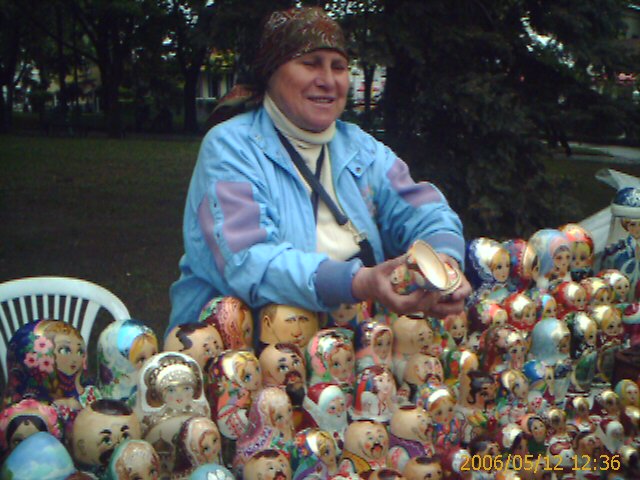 Yesterday I spent few hours going around Kharcov downtown. Fast food chains such as McDonald, Pissa, Coke ... are available. It is similar to other Western cities, Kharcov has its walking street, city square, city hall, Catholic churches which have golden domes, etc. Especially, Kharkov has Mother Square located inside a forest. At the Square I saw an everlasting fire and the sound of mother's heart. It is very symbolic.
Going to another park where locals sell paintings and souvernir gifts, I saw a woman who I took her photo above. Her face looks like the face of the mother statue in the forest. Kharcov does look like this woman - a woman without make-up.
Yesterday I spent few hours going around Kharcov downtown. Fast food chains such as McDonald, Pissa, Coke ... are available. It is similar to other Western cities, Kharcov has its walking street, city square, city hall, Catholic churches which have golden domes, etc. Especially, Kharkov has Mother Square located inside a forest. At the Square I saw an everlasting fire and the sound of mother's heart. It is very symbolic.
Going to another park where locals sell paintings and souvernir gifts, I saw a woman who I took her photo above. Her face looks like the face of the mother statue in the forest. Kharcov does look like this woman - a woman without make-up.
Friday, May 12, 2006
Teaching Management in Kharcov
 Kharcov is a big city but it is almost forgotten by the world. From the sky, you can see many huge deserted plants. At the Kharkov airport, many former Soviet civil aircrafts are landing on the ground forever. The airport station is old and poorly organized. Custom officers are awkward. It seems that the government does not have any interests in developing this airport.
Kharcov still has many huge buildings with a diverse city's transportation system building during the Soviet's regime. Roads are wide but their surfaces are getting worse. The city still maintains the electric railroads and electric buses for the public.
Nature in Kharcov is similar to middle, southern states of America. I come to the city at the beginning of summer. Trees are green and wild flowers are blooming because weather is warm. However, on the streets people are walking or waiting buses silently. What are they thinking of, I wonder.
Kharcov is a big city but it is almost forgotten by the world. From the sky, you can see many huge deserted plants. At the Kharkov airport, many former Soviet civil aircrafts are landing on the ground forever. The airport station is old and poorly organized. Custom officers are awkward. It seems that the government does not have any interests in developing this airport.
Kharcov still has many huge buildings with a diverse city's transportation system building during the Soviet's regime. Roads are wide but their surfaces are getting worse. The city still maintains the electric railroads and electric buses for the public.
Nature in Kharcov is similar to middle, southern states of America. I come to the city at the beginning of summer. Trees are green and wild flowers are blooming because weather is warm. However, on the streets people are walking or waiting buses silently. What are they thinking of, I wonder.
Monday, August 15, 2005
The traffic light and global integration (posted on Saigontimes weekly
Thanks to my network of friends, I often travel along the country. Hanoi is a historic capital city, but it is small, especially for roads. Recently, Hanoi has established the traffic light system. It seems that this is an automatic control system, because I do not see anyone to operate it.
When I visit Nha Trang (my home city ten year ago,) I am surprised because it is a small city, which has about 300,000 people, but the city also established traffic signal on some main roads downtown. A friend, who is working at the Communication and Transportation Department, told me the reasons, "Our city is small, it does not need a traffic signal system indeed. However, we need to train people to get acquaintance to the modern system."
In Ho Chi Minh City, where I am living, the traffic signal system has many forms, high and low, old and new. Interestingly, in some main roads, policemen still operate the flows of traffic manually. They use an operational box etablished next to the traffic light to control the flows of traffic.
To my knowledge, in order to establish the city traffic system, we need to collect data on the flows of transportation in the city. The interval of red or green lights will be decided depending on the time period of a day and the flows of vehicles. The police, who stands in a corner of a street, can not see the whole system. He can make decision at his cross road but he damages the traffic flows in other points of the city.
We can draw the lessons of operating traffic system in Vietnam and view them under the light of the regional, global integration process of the country: Ho Chi Minh City, a big city, but it is still struggle with old and new ways of doing things. Nha Trang is learning to adapt the new life and Ha Noi is courage moving forward! Besides, when the country gradually integrates into an interdependence economic trading system, you can not make decisions without thinking about the others!
Friday, June 17, 2005
An MC at entry level
The first time in my life, today I do the job of an MC for my former employer. I am not satisfied with my performance. I need to practice and learn more to become a professional. Am I too old to do so?
Thursday, June 16, 2005
Working harder or working smarter
"What do you think about Vietnamese?" "Well, your people are hard working and very determined."
I have never heard about "working smart" when foreigners perceive about Vietnamese in general. For a long time, I did not recognize the difference between "working hard and working smart."
Studying "work planning and time management" I believe Vietnamese must start learning working smart to transform their destiny.
Wednesday, June 15, 2005
Kid is kid
Calista visited our home. According to her Dad, she is five years old and that was the first time she stayed out of her family. Probably, she is a typical American kid. She said, "I don't need you to ask my Dad for the permission." She got permission of course, took her back bag and rode with me and my daughter on motorcycle to my house.
"Your house is far away! Your house is small and hot! (My daughter turned the air conditioner to the lowest range but our side her room it was still hot.)
At 9pm, my wife was anxious looking an American kid eating. 1030pm, my wife started worried because she saw Calista still wanted to play with my kids. 11:30pm, Quyen was tired and felt sleep. Ngoc came back her room to prepare for her study. Calista took her back bag and knocked Ngoc's bed room asking to take her home. Ngoc woke me up and I saw Calista in front of my bed room. She looked like a tiny soldier. I recalled an old story, "The Small Prince." All my family members surrounded her and were laugh when she said, "Because nobody wants to play with me, I must go home now!"
She started to cry. My wife and Ngoc took her home. On the way, she felt asleep because it's cool and Saigon was quiet. However, she did wake up and say "Good night" when she was in her Mom's arms.
Saturday, April 30, 2005
Writing from Hong Kong International Airport
It is interesting! I am standing and writing from an internet corner at HK International Airport. This is the world's best airport! There is no sense of terrorism! I do not see any police.
I spent one day at the airport and got an Asian and an American meal. Burger King makes me remember my old time when I was a graduate student in the U.S.
I look forward seeing my home city, HCMC. Thinking about TSN Airport I am sad. Thirty years have passed today, April 30, but my country is still strugling with poverty!
Wednesday, January 12, 2005
Human deficiency- stories in an elevator
Have you ever met a situation like this? My friend asked suddenly when he met me in the elevator led to our office on the 14th floor. He was not wait for my words but continued to tell his problem. "You know, I love my mom so much and take her from my home province to HCMC. However, my mom and my wife can not live with each other peacefuly. Mom gets angry when I tell her what is wrong and right from the story occured between two beloved folks. Mom says that now I have a young and beautiful woman and I do not pay much attention to her. She says she needs not to stay in HCMC and insists me to send her home.
Another friend, who was with us in the elevator, followed my friend's foot steps. He added, "I have something in common. I probably get a good job compared to other members in my family. However, it appears that my brothers and sister do not like me as they did when I was a student. They feel a complex when they see gifts I buy for my mom.
I said goodbye to my friends but I was thinking much about a story that another friend told me yesterday. He said, this year he was a star at his office. The sales volume, he earned, was highest among his colleagues in his company. Bosses call him for every meeting and some consultations. However, the more connections he gets from the bosses, the less friendship he receives from friends and colleagues.
Is there any correlation among three stories? I much do a research and tell you later.
Tuesday, January 11, 2005
A positive sum game
My family went to Dalat for vacation. We went to Dalat market for lunches everyday. The first day, we went to a very crowded restaurant. Waiting for the available seats, another restaurant's owner, who was selling soft-drinks, waved and offered us the seats. We got lunch and did not forget to reward her some drinks.
We went to another restaurant the next day. The owner was so busy with many customers while her neighbor did not have anyone. The neighbor went to the busy one. She washed dishes, cleaned tables and delivered meals. When I asked, "why do you work for your competitor?" With a smile, she said, "Tomorrow, if I am busy, my neighbor may help me."
Thursday, December 30, 2004
A hundred mile relative away may not as important as neighbors
Today, many countries are aware of the importance of international trade to their economic development. When countries are sending more and more delegations overseas to look for trade opportunities, some local authorities forget to welcome foreigners who come and visit at their homelands.
Last month, a foreign delegation failed to meet with local reporter to do an economic development promotion in Camau province, Vietnam. The foreigner wanted to have an interview with local reporters right at a bridge built by his country's financial aids.
A local cadre-in-charge did not allow local reporters to do their job just because of a simple reason, "They have had a lack of experience doing interview with foreigners"
Vietnamse have a proverb, "Ban ba con xa, mua lang gieng gan." (meanings, a hundred mile relative away may not as important as neighbors.) Probably, this cadre forgot his ancestors' advice!
Tuesday, August 31, 2004
Bye Bye AMB Raymond F. Burghardt
AMB came back Saigon (HCMC) to say good-bye to American and Vietnamese business community yesterday. It is nice to hear from a diplomat who has been dedicating his career in East Asia Pacific nearly half of his life.
AMB Burghardt reviewed current relationship between America and Vietnam and he is positive about future diplomatic relations of the two countries. He showed an example about the U.S. Congress' approval for his ambassadorship and his predecessor, AMB Peter Peterson. He said, AMB Peter Peterson had to wait several months (9 months, inauditable) to get his job as the first U.S. Ambassador to Vietnam since 1975. But, today, there may be nobody in the U.S. Congress posts that question when giving approval for the position.
However, he still sees some sensitive issues that can give a negative impact on the diplomatic relations between the U.S and Vietnam. For instance, Vietnamese American community in the U.S. may have certain impacts on U.S. senators' decisions for their issues and concerns in Vietnam, such as human rights and religious freedom. "Today foreign policy may not decide by governments but it may be influenced by third parties such as NGOs, volunteer groups or business community." He added.
"If you had three more years in Vietnam, what would you do?" one asked. AMB Burghardt said he would bring more big American companies to Vietnam, work out U.S.-VN adoption negotiation, do more on culture and arts exchange programs and importantly, he would work tirelessly on law enforcement for Vietnam...
Good bye AMB Raymond Burghardt, we know you love Saigon. Welcome back at anytime!
Wednesday, July 14, 2004
Secrets in DC - Continued
 At the center of Washington DC, Washington Monument looks like a sharpen pencil erecting against blue sky. At night, it looks more beautiful by white laser beams around the column and yellow lights on the top.
Washington Monument adopts the structures of Egyptian pyramids wishing for the longevity of America. As you climb to the top of the monument, you reach the highest point in DC. However, its shadow in the Reflection Pool reminds you that you are also at the bottom.
How does this tell you? You can learn many things from this implication, such as Don’t be arrogant if you are super! Or, America is the paradise, but it is the hell too!
At the center of Washington DC, Washington Monument looks like a sharpen pencil erecting against blue sky. At night, it looks more beautiful by white laser beams around the column and yellow lights on the top.
Washington Monument adopts the structures of Egyptian pyramids wishing for the longevity of America. As you climb to the top of the monument, you reach the highest point in DC. However, its shadow in the Reflection Pool reminds you that you are also at the bottom.
How does this tell you? You can learn many things from this implication, such as Don’t be arrogant if you are super! Or, America is the paradise, but it is the hell too!
Thursday, July 08, 2004
Secrets in DC
 My colleagues and I were very excited about America. Remember, we have been working for American Embassies and Consulates for at least five years!
Why? If you take time to view my blog, you certainly can see many stories that I learnt from my trip to the U.S. One thing I need to tell you is that you must keep patience because I must do my work daily and will not give you my promise when I post my stories.
Well, here is the first secret!
Do you know that Abraham Lincohn statue has two faces? When you see his statue from the front of his monument, you will see his true face. If you see him from the left or right of the statue, you will see the other face behind his head!
How does it look like? It looks like your face, my face and anyone face. The implication is that althought Abraham Lincohn freed slaves, saved American democracy, many people saw his decision was wrong.
Sometimes in our life, we may encounter this problem. So, don't be sad, my friends. C'est la vie!
My colleagues and I were very excited about America. Remember, we have been working for American Embassies and Consulates for at least five years!
Why? If you take time to view my blog, you certainly can see many stories that I learnt from my trip to the U.S. One thing I need to tell you is that you must keep patience because I must do my work daily and will not give you my promise when I post my stories.
Well, here is the first secret!
Do you know that Abraham Lincohn statue has two faces? When you see his statue from the front of his monument, you will see his true face. If you see him from the left or right of the statue, you will see the other face behind his head!
How does it look like? It looks like your face, my face and anyone face. The implication is that althought Abraham Lincohn freed slaves, saved American democracy, many people saw his decision was wrong.
Sometimes in our life, we may encounter this problem. So, don't be sad, my friends. C'est la vie!
You can see 4 Confucianism management principles at Geogre Washington House
Dear friends,
Do you want to train yourself to be a good citizen, good husband to your wife (wives!!!)- good dad to your kid (kids)- good staff to your organization - or even good future leader of a community or country?
Here is a secret! Let's visit George Washington Home at Mount Vernon, about 18 miles south DC.
George Washington house was built on a small hill next to Potomac river. From this house, people always have a far, beautiful panaroma view with five basic elements including fire, wood, water, earth and metal according to the Eartern philosophy.
Near to his own house is home of his slaves and the office of his personnel manager. Following on the right hand side is a food processing house, a house for acounting clerk, a spinning factory and a ferry on the bank of Potomac river.
You will see that Geogre Washington had operated 4 Confucianism management principles before he became the first American president.
The first princple is to control yourself.
The second principle is to manage your family.
The third principle is manage your village, your country.
And, then, the fourth principle is to manage the world
For that reason, George Washington was successful in the Civil War and became one of the founders of America to build up a rigid foundation for his country in the past years, today, as well as the coming decades.
Michael Moore's Movie - 9/11 Farenheight
9/11 Farenheight is a good documentary movie. My IRO, Luella David and many viewers including me were about moved to tears when we saw again the Ground Zero aftermath.
However, in my opinion, it is bias and seen as an effort to defeat Bush administration.
Monday, June 28, 2004
ALA continued
ALA is huge! I spent two days but could not go for all. That is amazing!
Last night, we went to Universal Movie Theater and had a lot of funs. I dare not to go back although i really appreciate technology and innovation at the movie shows.
Tonight, I will see the 9-11 Farenheight, a controversy movie. Let me see and tell you later,
Bye
Sunday, June 27, 2004
ALA Orlando
The weather in Orlando is somehow similar to HCMC (Saigon)- Vietnam. Yesterday, there was a big thunder storm, but it stopped at midnight.
American people are so lucky! Everything here is cheaper than even in Vietnam. A home theatre costs only $300! A good T-shirt is only 2 bucks.
ALA Conference is the national one and it is huge and very well-organized. We come to see and pick up small gifts from many vendors. This is the day for all American librarians. There are so many lectures and presentations.
Technology is making library work even more efficient, important in the coming decades.
Friday, June 25, 2004
Bye Bye Boston
Bye Bye Boston,
I am heading for Orlando tomorrow. Today, the Chair of the Commonwealth of Massachusetts House of Representatives Marie J. Parente receives us and gives us a tour in the MA State House.
It is surprised to me, she becomes the tour guide and explains us the history of over 300 years of Boston, MA.
Probably, when I come back Vietnam, I should introduce this story to Vietnamese National Assembly Members or raise an issue such as How to do marketing for the public sector. That is an interesting topic. Do you think so?
Subscribe to:
Posts (Atom)